Impact of Electric Fields on the Alignment of Clay Particles
Thesis submitted for the degree of PhD
Faculty of Mathematics and Natural Sciences — Department of Physics
University of Oslo, Norway
March 2014
Supervisors: Prof. Knut Jørgen Måløy (main), Prof. Jon Otto Fossum, Prof. Eirik Grude Flekkøy
Preface
This work presents experimental work done in the AMKS group at the University of Oslo between 2009 and 2014 under the supervision of Knut Jørgen Måløy, with co-supervision from Jon Otto Fossum and Eirik Grude Flekkøy. The work was funded by the Norwegian Research Council Nanomat programme 182075 with some additional funding from the group and the University.
The work is primarily based on the orientation and ordering of particles on application of electric fields. Most of the work was performed either in K. J. Måløy’s laboratories at Oslo University or at NTNU Trondheim, in J. O. Fossum’s laboratories. In addition some X-ray studies were done at the European Synchrotron Radiation Facility in Grenoble, France.
This work is split into three main projects: rotation of clay particles, electric alignment of clay particles in paraffin, and active structuring of colloidal armour on liquid drops. All three projects rely on three important components: an electric field to align the particles, a viscous fluid to suspend the particles, and a reaction between the particle and the applied field.
Overview
As our technology develops we are more reliant on smaller structures and more complicated materials. This thesis is concerned with aligning clay particles using an electric field — a subject with broad implications for nanocomposite materials, electrorheological fluids, and self-assembling surface structures.
Clay minerals are hydrated phyllosilicates that make up the fine-grained fraction of rocks, sediments and soils. The thesis works primarily with fluorohectorite (a 2:1 synthetic clay) and vermiculite. When clay particles are suspended in an insulating fluid and subjected to an electric field, they undergo four stages: polarisation, rotation and alignment, chain formation, and chain coarsening.
Project 1 — Rotational alignment
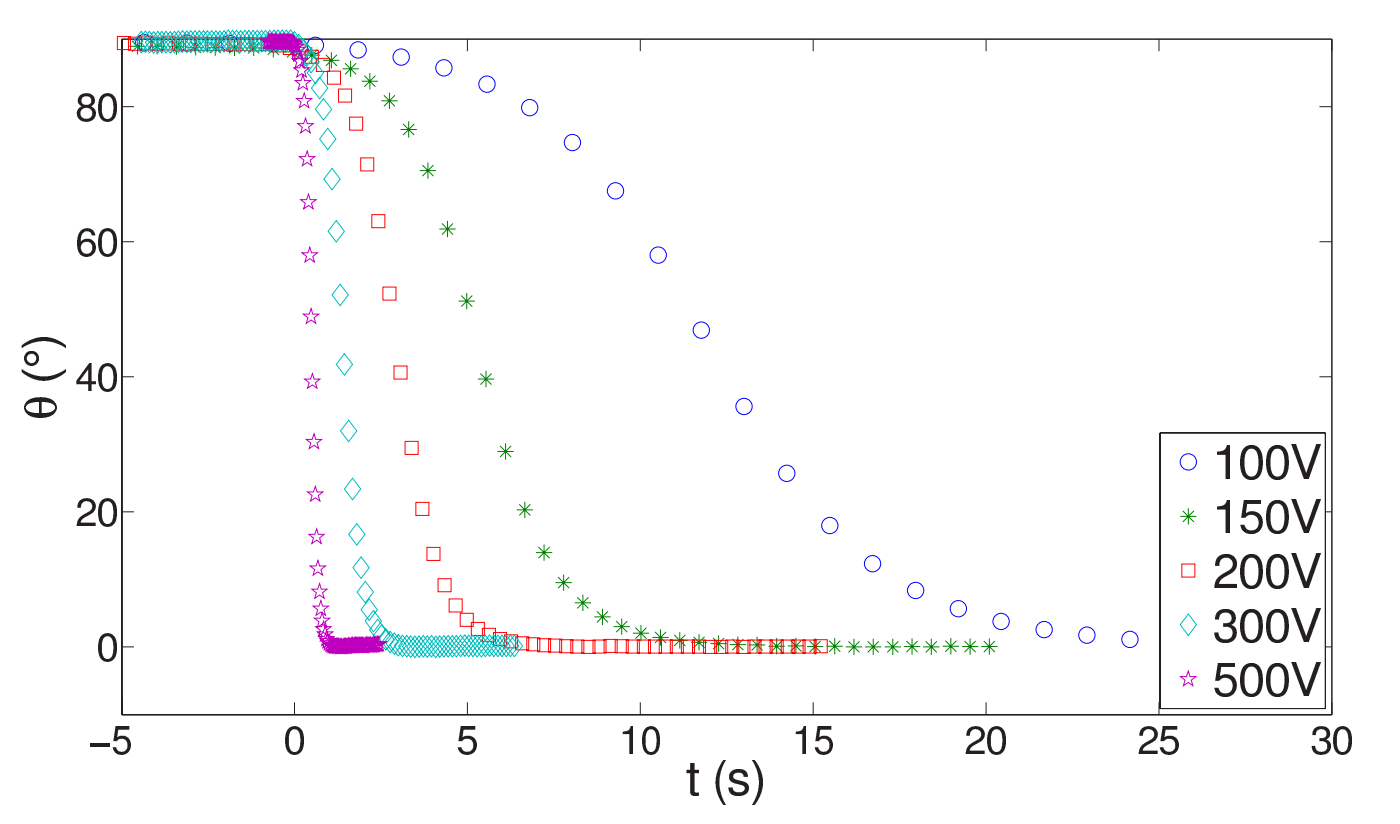
Initial studies investigated the rotation of individual clay particles in an electric field. A single particle was suspended in silicone oil, allowing precise measurement of alignment properties as a function of field strength, carrier fluid viscosity, and the hydration state of the particle. A data collapse of the alignment angle versus time was achieved by normalising time by the square of the electrical field.
Clear field and viscosity dependencies on the rotation rate were found. There was also an increase in rotation rate as a particle’s hydration level was increased. The change in polarizability of a clay particle increases and peaks at a width/length ratio of 0.24.
Project 2 — Electric field alignment in an oligomeric matrix
Synthetic fluorohectorite dispersed in paraffin wax was studied when aligned using an electric field. It was found that the anisotropic ordering of clay particles could be preserved in the paraffin matrix even after complete solidification, with only a small loss in order when the paraffin wax solidified. The paraffin wax also delayed the clay from absorbing water and changing hydration state — even after six months, a large population of clay particles retained zero intercalated water.
Project 3 — Active structuring of colloidal armour on liquid drops
A silicone oil drop placed in a bath of castor oil, with clay or polyethylene particles suspended in the silicone oil, was exposed to an electric field. Particles migrated to the surface of the drop forming a colloidal armour ribbon. By adjusting the electric field the convection within the drop could be controlled, dynamically opening and closing a “pupil” of uncovered surface. This offers a novel route to creating and controlling structured particle-coated droplets.
Conclusions
The work demonstrated clear field and viscosity dependencies on the rotation rate for a particle rotating in an electric field. It was shown that the anisotropic ordering of clay particles can be preserved in a paraffin matrix upon solidification. The colloidal armoured drop experiments showed interesting ways of organising particles within a drop — particles self-organise to form a ribbon around the drop due to hydrodynamic flow, which can be dynamically reformed by adjusting the applied field.
List of Papers
-
Electric field nematic alignment of fluorohectorite clay particles in oligomeric matrices
Z. Rozynek, R. C. Castberg, A. Mikkelsen, J. O. Fossum
J. Matter. Res. 28, 1349–1355 (2013) -
Clay alignment in electric fields
R. C. Castberg, Z. Rozynek, J. O. Fossum, K.J. Måløy, P. Dommersnes and E. G. Flekkøy
Rev. Cub. Fis. 29, 1E28 (2012) -
Dipolar ordering of clay particles in various carrier fluids
Z. Rozynek, H. Maurøy, R. C. Castberg, K. D. Knudsen and J. O. Fossum
Rev. Cub. Fis. 29, 1E37 (2012) -
Active structuring of colloidal armour on liquid drops
P. Dommersnes, Z. Rozynek, A. Mikkelsen, R. Castberg, K. Hersvik and J. O. Fossum
Nat. Comm. 4, 2066 (2013) -
Insight into the alignment of clay platelets in silicone oil
R. C. Castberg, Z. Rozynek, P. Dommersnes, E. G. Flekkøy, K.J. Måløy and J. O. Fossum
(to be submitted)